Civil War Sharps Rifle Serial Numbers
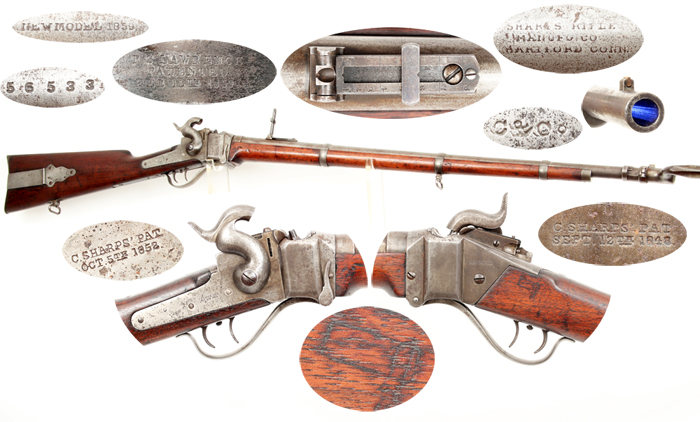
Reference Number G1141. Sharps Rifle Replica Civil War 1859. Movies & Series. Oh yes, Springfield Research Service might have the serial number of your Sharps 'on file' as several gentlemen spent several years in the National Archives digging up the serial numbers of military issue weapons from the Civil War until the Post World War II era.
Download lagu dangdut koplo om terbaru. This 'slant breech' specimen is attributed to use by John Brown in his 1859 raid on the U.S. Armory at Harpers Ferry, Virginia. It is one of 75 whose serial numbers are listed in the CONGRESSIONAL RECORD for 1859 as a result of its association with that event. Over 900 of these 'Beecher's Bibles', named for abolitionist preacher Henry Ward Beecher, were purchased by New England abolitionists and shipped in crates marked BIBLES for the purpose of arming Free Soil settlers in Kansas during the 1850s.
John Brown was one of many anti-slavery settlers who fought against pro-slavery 'Border Ruffians' in Kansas prior to the Civil War, and some of these guns found their way with Brown to Harpers Ferry. Sharps carbines were manufactured with identical serial numbers on both the tang and on the underside of the barrel beneath the fore end. The tang serial number of this specimen has been removed, quite likely in an attempt to cover its role in Brown's abortive raid. However, the barrel serial number remains and is visible with the fore end removed, substantiating the role of this gun in a watershed event in U.S.
Christian Sharps (1811-1874) was the originator of a line of sturdy, practical, and popular military and sporting rifles and handguns that were associated with several events that shaped American history in 19th century, including armed conflict in Kansas during the 1850s, the Civil War, the era of the Plains buffalo hunter, and the rise of modern long-range competition shooting during the 1870s. Sharps worked at John Hall's Rifle Works in Harpers Ferry, Virginia, where he learned the principles of arms manufacturing. His first breechloading rifle design was patented in 1848, and the toggle-linking trigger guard and vertically operating sliding wedge breechblock of later Sharps rifles and carbines date from that patent.
These features are still with us today, and have seen use in both rifle and artillery breech mechanisms. Grafoplast si2k software s. The spring lever-toggle-breech mechanism of the Borchardt-Luger semi-automatic pistol also had its roots in Christian Sharps' lever-linked breech. In 1850, Sharps moved to Mill Creek, Pennsylvania, near Philadelphia, and contracted with the firm of A. Nippes to manufacture two of his sporting rifle designs, which became known as the Model 1849 and Model 1850. Faced with difficulty in obtaining financing for further ventures, Sharps left the Philadelphia area in 1851 and relocated to Hartford, Connecticut, where he formed the Sharps Rifle Manufacturing Company.
Lacking production facilities, he contracted with the Windsor, Vermont firm of Robbins & Lawrence to manufacture his new breechloader. This venture continued until 1855. Among the Sharps-designed firearms manufactured under this association were the Model 1851 'Box Lock' Carbine, which featured the Maynard tape primer system, and the Model 1852 and Model 1853 'Slanting Breech' Carbines, which were equipped with the Sharps-patented pellet primer system as an integral part of its breech mechanism. Model 1853 Carbines were nicknamed 'Beecher's Bibles,' after noted New York clergyman and abolitionist Henry Ward Beecher. Approximately 900 of these arms were shipped in heavy crates marked BIBLES for use by anti-slavery 'Free Soil' settlers who were fighting against pro-slavery forces in 'Bleeding Kansas' during the 1850s. One of the most famous Free Soilers was John Brown, who later used 300 Model 1853 Carbines in his ill-fated attempt to capture the U.S.